Gen Z and the Collapse
I first noticed that the world had changed at 3:07 in the morning.
At my age, nothing good happens at 3:07 in the morning. Either the heating makes a noise like a dying submarine, or one suddenly remembers an unpaid bill from 1998. In my case, I was standing in the hallway, trying to find out what was happening, when I saw a blue light coming from the living room.
A young friend, Cecile, was sitting on the sofa. She was twenty-two, long-legged, pale from screen light, and wrapped in a blanket like a nun who had lost faith in the monastery. Her phone glowed in her hands. Her face had the serious expression of a woman receiving urgent news from a collapsing empire.
I asked her what had happened.
She did not look up. She whispered, “OMG… what is happening?”
Now, in my youth, when someone said something like that at three in the morning, there was usually a gas leak, a police car outside, or somebody had tried to repair a motorcycle in the kitchen. But Cecile was not looking at danger. She was looking at a picture of a badly drawn medieval goose wearing a helmet.
Underneath the goose was the sentence: “Me after one professional email asks me to circle back.”
Cecile laughed.
Not politely. Not briefly. She laughed with the deep tiredness of a woman who had just seen her soul accurately described by poultry.
I stood behind her and waited for the meaning to appear. It did not.
“Why is the goose medieval?” I asked.
“That’s part of it,” she said.
“What part?”
“The whole mood.”
I nodded because, at my age, one learns to preserve dignity by pretending to understand things.
This was my first serious encounter with Generation Z humor. Until then, I had believed young people were simply young people, as they had always been. They wore strange clothes, used strange words, listened to music that sounded like a dishwasher full of cutlery, and eventually became tired adults who complained about taxes. That was the natural order. My parents had disliked my music. I disliked some modern music. Others dislike whatever Cecile listens to, although calling it music seems generous, like calling a vending machine a restaurant.
But Gen Z is different. They are not merely young. They seem to have been raised inside a machine that never sleeps.
My generation entered the internet like people stepping onto a frozen lake. We had lives before it. We had silence. We had boredom. We had afternoons where nothing happened, and nobody documented it. If we wanted to embarrass ourselves, we had to do it locally and hope the witnesses had poor memories.
Cecile’s generation has no such luxury. They were born into the feed. The feed was not something they visited. It was the weather around them. Friends, jokes, politics, dating, anger, news, work, shame, shopping, disasters: everything arrived through the same glowing rectangle. A war appeared next to a cooking video. A climate report came between a dog in sunglasses and a billionaire announcing another rocket. One swipe contained tragedy, advertisement, outrage, beauty tips, financial panic, and a man falling off a treadmill.
No wonder they speak in riddles.
Cecile once explained that the medieval goose was funny because it was absurd. I told her we already had absurdity in my youth. We called it government paperwork. She said that was different. Her generation did not use absurdity as decoration. They used it as protection.
That sounded dramatic to me until I started watching more closely.
This generation has grown up under a sky full of permanent warnings. Climate change is not an abstract debate for them. It is a notification. Economic insecurity is not a headline. It is rented. Artificial intelligence is not science fiction. It is the thing that might take their first job before they even get a proper office chair. Housing prices look like ransom letters. Politics feels like a family argument in a burning kitchen. And through all of this, they are expected to remain attractive, informed, employable, emotionally aware, socially responsible, digitally present, and somehow relaxed.
My generation had problems too, naturally. We had inflation, bad haircuts, cold wars, and cars that smelled permanently of petrol and regret. But we were allowed to be unreachable. That may have been one of the great forgotten freedoms of the twentieth century. You could leave the house and vanish for six hours. Nobody tracked your location. Nobody expected a reply within seven minutes. If you did not answer the phone, the world assumed you were busy, not morally defective.
Cecile’s phone is never truly silent. It vibrates like an anxious insect. Messages arrive. News arrives. Work arrives. Memes arrive. Someone somewhere is offended, selling something, confessing something, exposing something, or reacting to something. Her attention is not her own. It is rented out in tiny pieces to companies with friendly logos and extremely serious data departments.
Under such conditions, I began to understand why a goose with a helmet might feel emotionally accurate.
One Sunday afternoon, Cecile tried to explain post-irony to me. I had made coffee, real coffee, not oat foam served in a laboratory beaker, and she sat across from me at the kitchen table.
“It’s when something is a joke,” she said, “but also not fully a joke.”
“That’s called lying,” I said.
“No, it’s more like being sincere through pretending not to be sincere.”
“That is also lying, but with theatre.”
She sighed with the patience young people reserve for older men and printers.
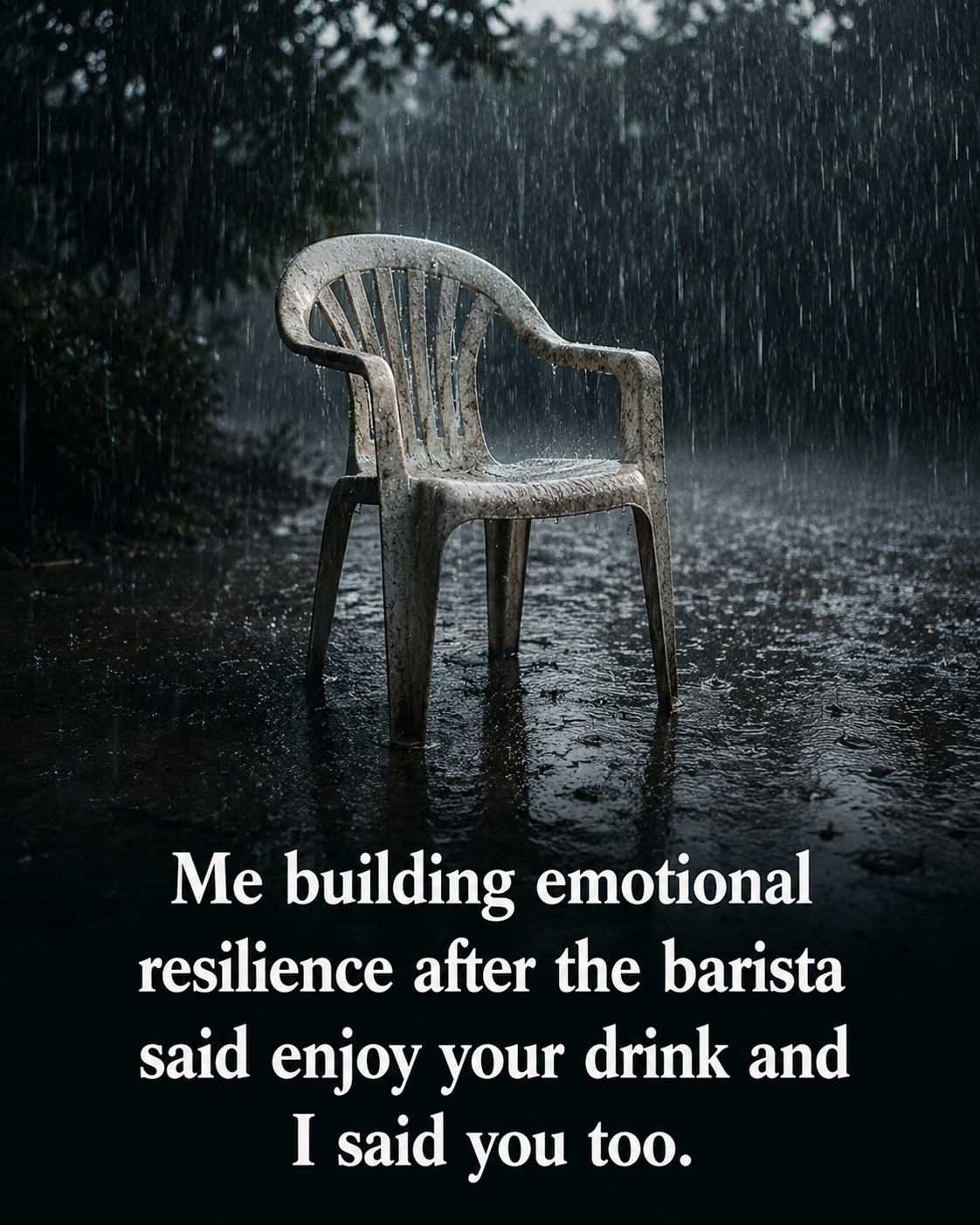
She showed me a post. It was a photo of a plastic garden chair standing alone in heavy rain. The caption read: “Me building emotional resilience after the barista said, ' Enjoy your drink and I said, ' You too.”
I looked at it for a long time.
Then, against my will, I laughed.
Not because the chair was funny. The chair was barely furniture. But I understood the feeling. The tiny social mistake that grows in your mind until you become convinced you must leave the country and start again under a new name. In my youth, we suffered such moments privately. Gen Z turns them into public folklore.
That, I realized, is part of their strange genius. They compress embarrassment, fear, and exhaustion into jokes so small and stupid that they become bearable. A picture of a wet chair says what a diary entry once said. A frog on a broken office printer becomes a confession. A dog staring blankly at a wall becomes therapy with fur.
Older people often accuse Gen Z of being lazy, narcissistic, or too sensitive. This is one of our favorite habits: misreading younger people with great confidence. The Greeks complained about youth. The Victorians complained about novels. My parents complained about electric guitars. We complained about video games. Now people complain because teenagers use a sad hamster to explain emotional burnout.
Civilization is mostly one long chain of older people misunderstanding jokes.
But when I watch Cecile and her friends, I do not see laziness. I see a kind of exhaustion I did not know at their age. They are always performing and always aware of performing. Social media has turned personality into a stage. Every hobby can become a brand. Every meal can become content. Every opinion can become evidence in a future trial conducted by strangers with cartoon-animal profile pictures.
When I was young, if you went jogging, you went jogging. You put on terrible shorts, ran badly, sweated honestly, and returned home. Now people optimize wellness journeys. If they drink coffee, it is not coffee. It is a morning ritual. If they are sad, it is not sadness. It is content with soft music and a caption about healing.
Cecile knows this is absurd. Her friends know it too. That is why they mock it while participating in it. They pose and laugh at posing. They care and pretend not to care. They post, “I am entering my soup era,” and somehow everyone understands it means they are tired, broke, and considering canceling plans.
Corporations, naturally, try to copy this language because corporations see human emotion the way mosquitoes see ankles. They want access. They want engagement. They want the precious young people to believe a sandwich brand has a personality.
I once saw an advertisement from a bank that said, “Adulting hits different.”
I felt physical pain.
Cecile said, “That is not how we talk.”
Which is interesting, because sometimes it is exactly how they talk. But when a company does it, it becomes dead on arrival. Gen Z can smell artificiality the way dogs smell fear. They have grown up surrounded by advertising disguised as friendship, influencers disguised as ordinary people, politicians disguised as concerned citizens, and brands disguised as activists. No wonder their humor became a defense mechanism.
They distrust polished perfection. It looks expensive. It looks managed. It looks like a meeting happened.
This may explain why Cecile recently bought an old film camera from a flea market. It barely works. The leather is peeling. The light meter is probably as honest as a used-car salesperson. She loves it.
I asked why she wanted such an inconvenient thing when her phone could take sharper pictures than anything I owned in 1982.
She said, “Because the phone makes everything look too clean.”
That sentence stayed with me.
Too clean.
Perhaps that is the key. Gen Z has lived inside digital cleanliness for so long that imperfection now feels truthful. Grain feels human. Blur feels alive. A scratch on film says time passed here. A bad exposure says someone stood in real light and made a real mistake. In a world of filters, mistakes become evidence.
Their humor works the same way. It is ugly on purpose. Distorted images, strange captions, broken grammar, random animals, medieval paintings with modern anxiety. It rejects smoothness. It refuses to be a motivational poster. It says: "Life is strange. I am tired. Here is a penguin with a briefcase."
And somehow that feels honest.
One evening, Cecile showed me another image. It was a poorly edited picture of an office printer on fire. Sitting beside it was a calm-looking rabbit. The caption said: “Me maintaining a professional tone.”
I laughed immediately.
She looked proud, as if I had passed a citizenship test.
The more I listened, the more I realized their nonsense has structure. It is not random in the way spilled soup is random. It is random, like dreams. Strange, but emotionally precise. The images do not explain. They suggest. They create an atmosphere. Traditional jokes point to a punchline. Gen Z jokes point to a mood.
And the mood, very often, is: I am overwhelmed but still here.
That is nothing.
My generation was not always good at speaking about feelings. We had two emotional settings: fine and dead. Men, especially, were trained to treat vulnerability like a suspicious package. If something hurt, you worked more, drank more, repaired something badly in the garage, or developed opinions about lawn care.
Gen Z talks about anxiety, burnout, boundaries, and therapy with astonishing openness. Sometimes too openly. I once heard Cecile’s friend describe a disappointing pizza as “emotionally unavailable.” I nearly dropped my fork.
But beneath the exaggeration is progress. They have words for things we swallowed. They notice patterns we ignored. They understand that silence is not strength if it slowly poisons the room.
Still, openness has a cost. If every emotion can become public, every emotion can also become performance. That is the trap they live in. They crave sincerity but distrust it. They want connection but fear exposure. They are lonely together, surrounded by endless contact and not enough touch, endless communication and not enough peace.
So they make jokes.
Dark jokes. Strange jokes. Jokes that look like nonsense until you stand close enough to feel the heat coming off them.
During crises, they create memes almost instantly. Older people sometimes call this disrespectful. I once thought so too. Then I remembered funerals where people laughed in the kitchen after crying in the chapel. I remembered hospital corridors where relatives made terrible jokes because the alternative was falling apart. Human beings have always used humor to carry fear without dropping it.
Gen Z does this in public, at high speed, with raccoons.
There is something both tragic and impressive about that.
The world they inherited is not stable, yet they are expected to act normally. The old promise of adulthood has weakened. Study hard, get a good job, buy a house, retire safely. It sounds almost charming now, like an advertisement for a country that closed years ago. Cecile’s friends work hard, but many do not believe hard work guarantees safety. They believe the ground moves. They have reason.
So when they joke about being “emotionally a broken vending machine,” perhaps they are not avoiding reality. Perhaps they are describing it as clearly as possible.
One night, around three in the morning again, I found Cecile on the sofa. Same blue light. Same blanket. Same look of sacred exhaustion. This time, I did not ask what was happening. I sat beside her.
She showed me a picture of a tiny ceramic horse standing on a windowsill. Behind it, the sky was grey. The caption read: “Still here, unfortunately iconic.”
I read it twice.
Then I laughed.
Not because I fully understood the rules of her world. I do not. I still believe phones should have buttons, cars should not update themselves, and coffee should not require vocabulary from a chemistry exam.
But I understood the feeling.
Still here.
That is what all the absurdity means. Beneath the irony, the strange animals, the medieval geese, the burning printers, and the tired little horses, there is a generation saying: we see the mess, we know the performance, we feel the pressure, we are frightened, and we are laughing anyway.
Maybe that is not the collapse of meaning.
Maybe it means trying to survive in disguise.
And if a twenty-two-year-old needs a blurry goose in a helmet to say that, then so be it.
I have seen worse methods. I lived through disco.