Beaten for Fifty Dollars
Hong Kong: Where Your Enemies Get Beaten for Fifty Dollars
An afternoon beneath Goose Neck Bridge
There are many ways of dealing with people who have made themselves unpleasantly memorable. Some people prefer confrontation, others practise forgiveness, and a surprisingly large number spend years telling their friends precisely what they should have said at the time. The more technologically advanced among us simply block a telephone number and consider the matter settled, although the satisfaction rarely lasts.
Hong Kong, however, offers another possibility. For fifty Hong Kong dollars, roughly the price of a decent coffee and a small pastry, you can have your enemies beaten with an old shoe.
There is, naturally, a certain degree of symbolism involved. The enemy is represented by a small paper figure, which seems an admirably sensible arrangement. Nobody gets hurt, the police remain undisturbed, and the practitioner earns an honest living. Compared with the expense and inconvenience of actual revenge, it strikes me as remarkably efficient.
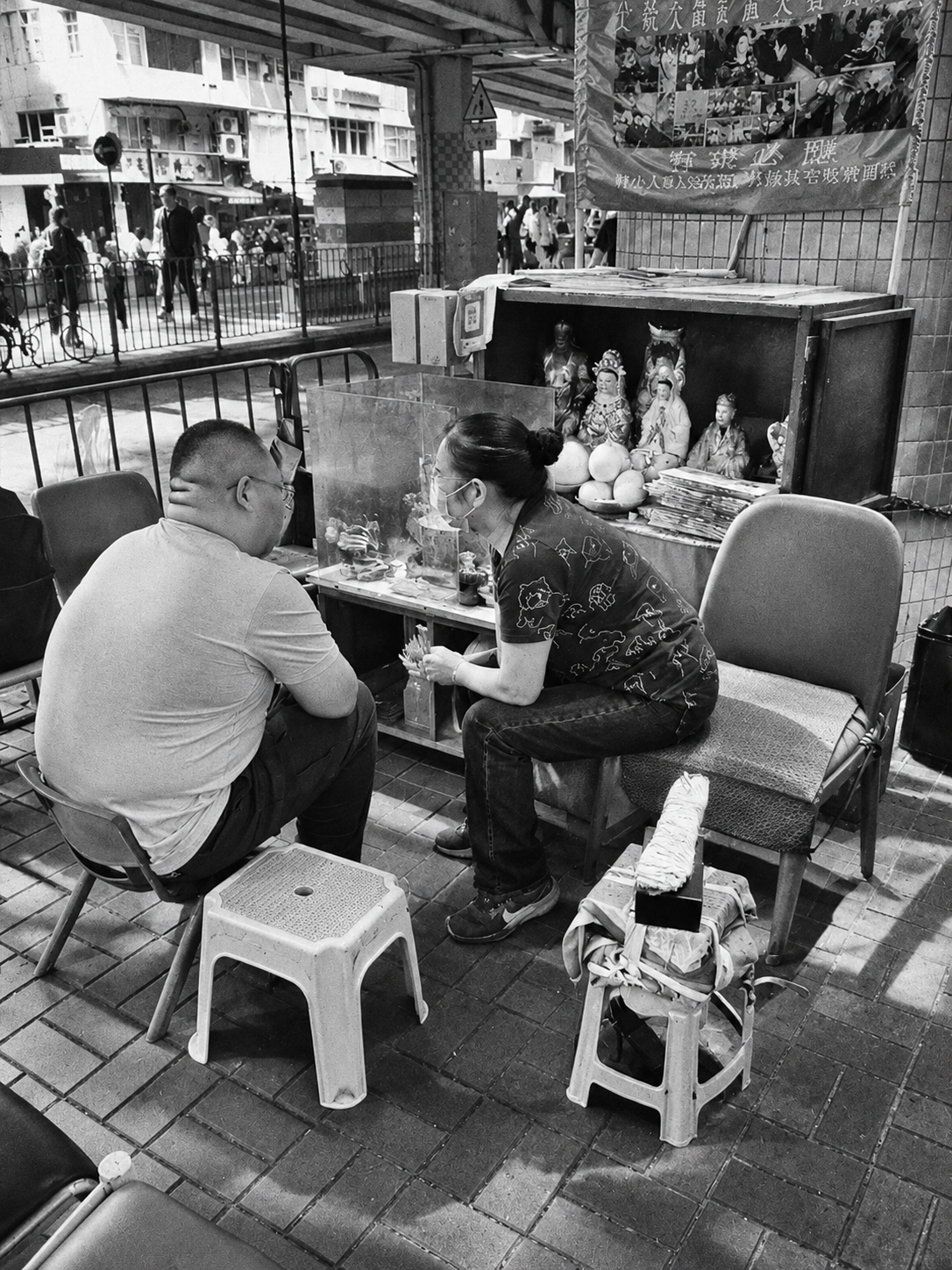
I came across this unusual form of conflict resolution beneath Goose Neck Bridge in Causeway Bay, where the traffic above continues its daily battle for survival while an entirely different struggle takes place below. Buses rumbled overhead, taxis squeezed through gaps that seemed to exist only in the imagination of their drivers, and pedestrians hurried past with the familiar determination of people who had already been late for something before leaving home.
Beneath the bridge, however, time appeared to follow a different rhythm.
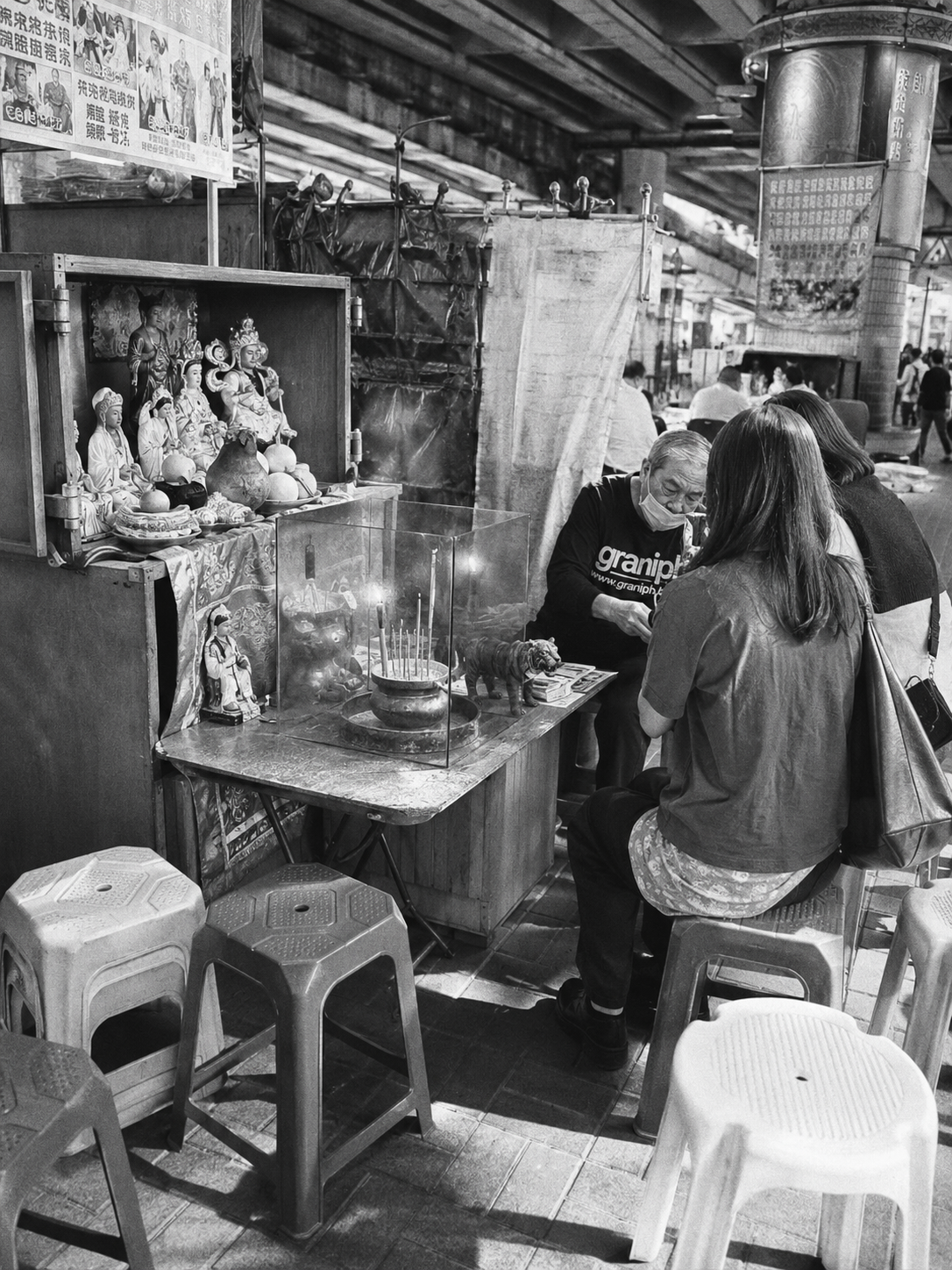
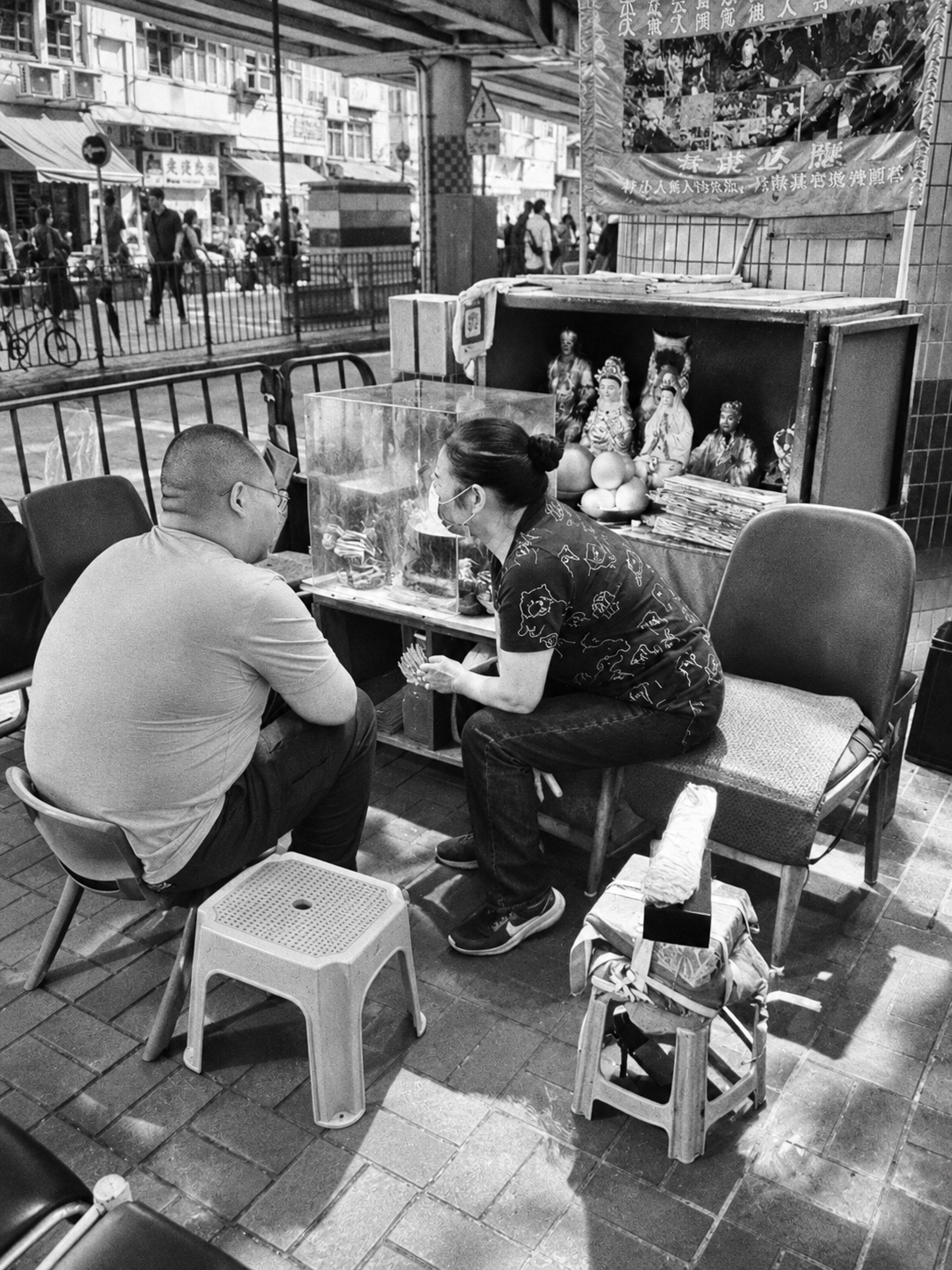
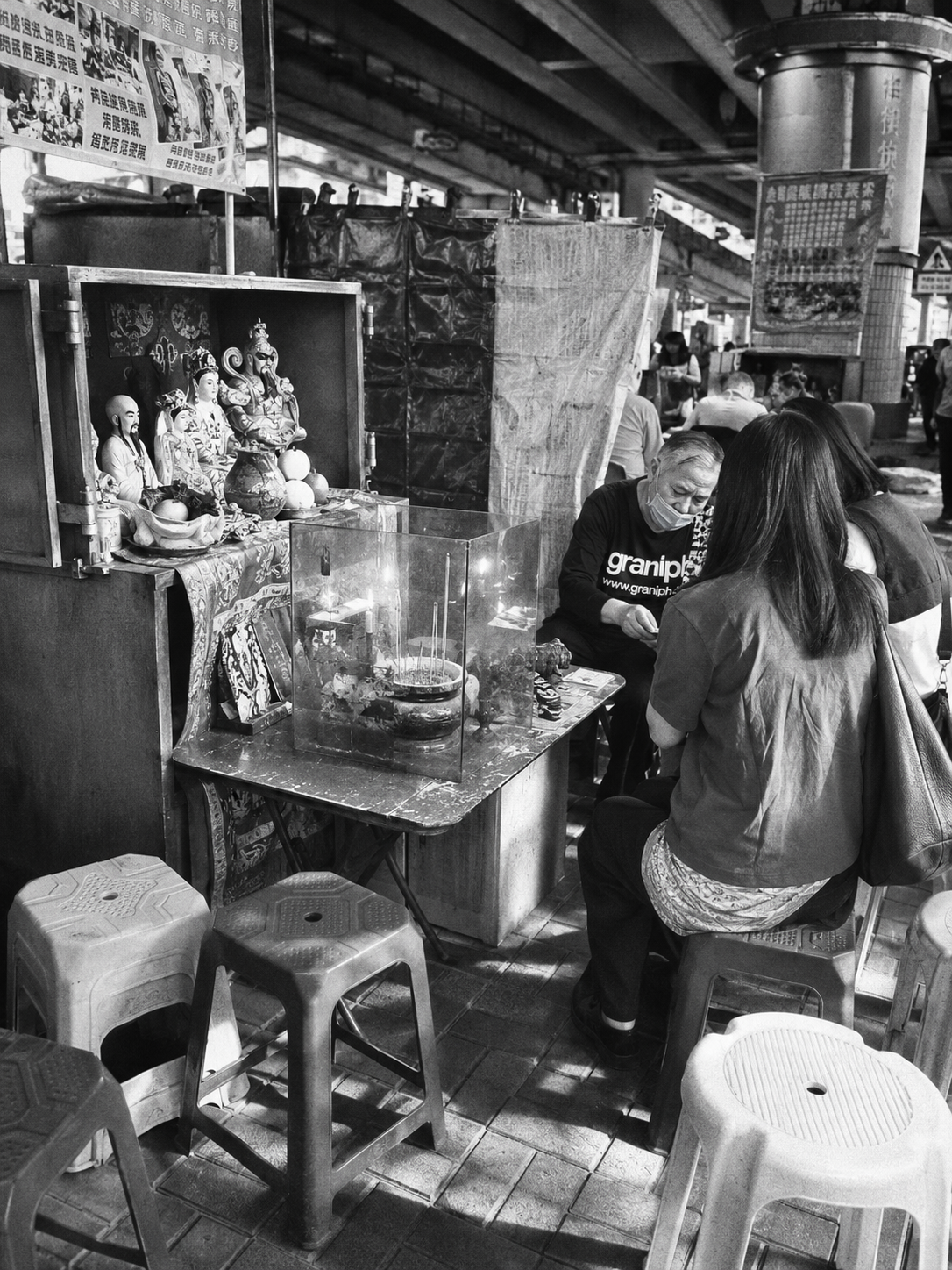
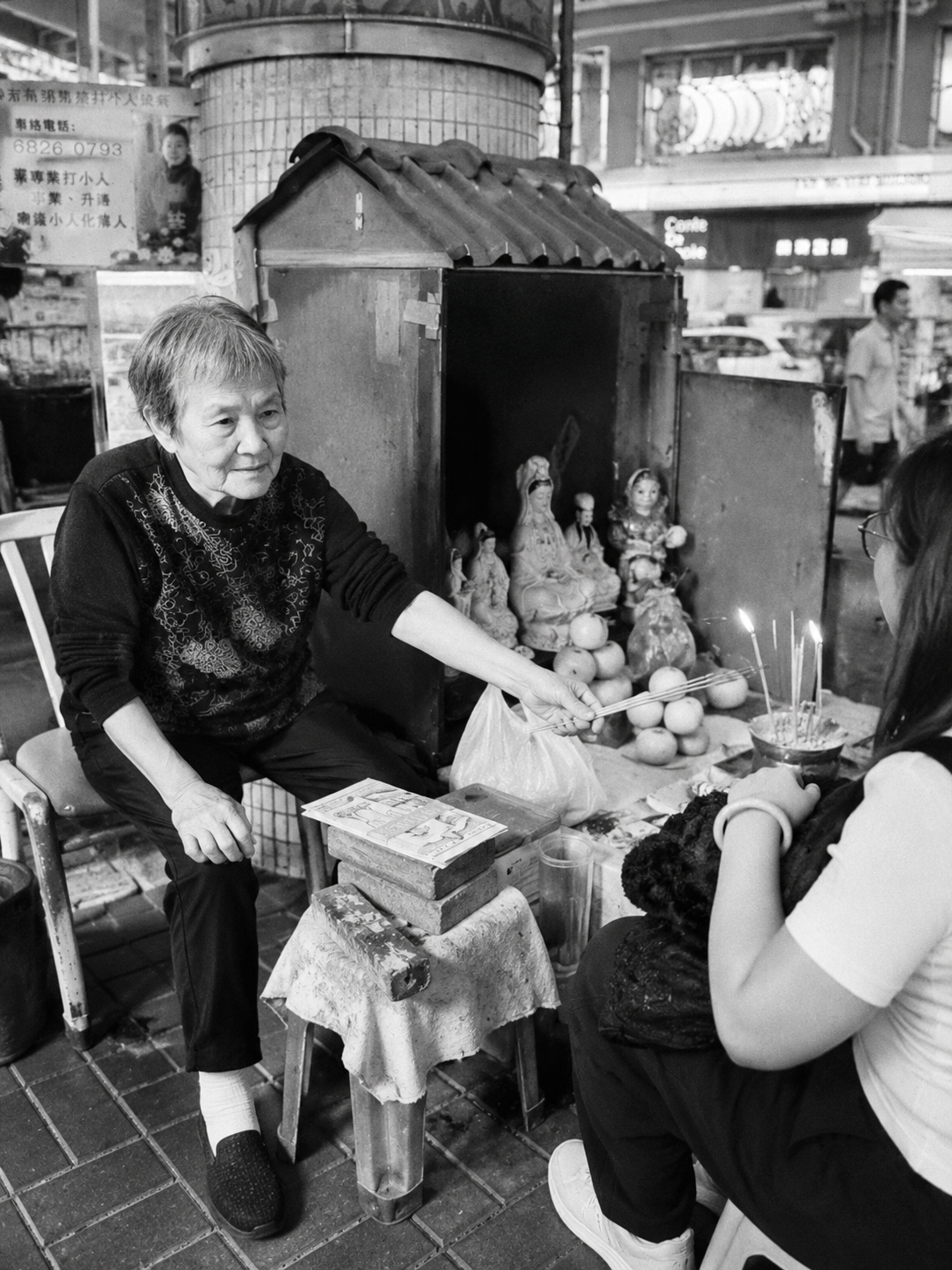
Small altars stood beside plastic stools. Incense smoke drifted between handwritten signs and folded pieces of red and yellow paper. Religious offerings were arranged with the care normally reserved for expensive restaurant dishes, while a collection of old shoes lay ready for duties considerably more demanding than walking.
I had come with my camera, as I usually do when I suspect that ordinary life might reveal something extraordinary. Some visitors travel to Hong Kong for its restaurants, others for its shopping or spectacular skyline. I seem to have developed the habit of travelling halfway around the world to photograph elderly women assaulting pieces of paper.
Among the practitioners was Auntie Yung, also known as Rong Gu, whose advertisement presented a professional career of almost intimidating versatility. She offered Feng Shui consultations, fortune-telling, face reading, auspicious dates, name changes, marriage blessings, career improvements and spiritual guidance. She could examine your Eight Characters of Destiny, communicate with the spirit world, assist with troublesome relationships and offer protection against influences that most people would struggle even to identify.
Her expertise apparently extended to appeasing Tai Sui, making offerings to the White Tiger, sending away the Heavenly Dog and removing five ghosts, while simultaneously attracting wealth, helpful benefactors and favourable employment opportunities.
I wondered whether she might also deal with delayed flights, missing luggage and people who stop without warning at the top of escalators. These, in my experience, are among the more persistent evils of modern civilisation.
According to her advertisement, Auntie Yung had studied traditional Maoshan spiritual practices and belonged to a distinguished lineage of masters associated with Guangxi. She had appeared on supernatural radio programmes, performed consultations during live broadcasts and attracted the attention of television crews and journalists.
It was an impressive professional history. Most people spend their working lives trying to become reasonably competent at one occupation. Auntie Yung appeared to have mastered the entire human condition, including several departments whose existence remains a matter of debate.
And she conducted her business beneath a flyover.
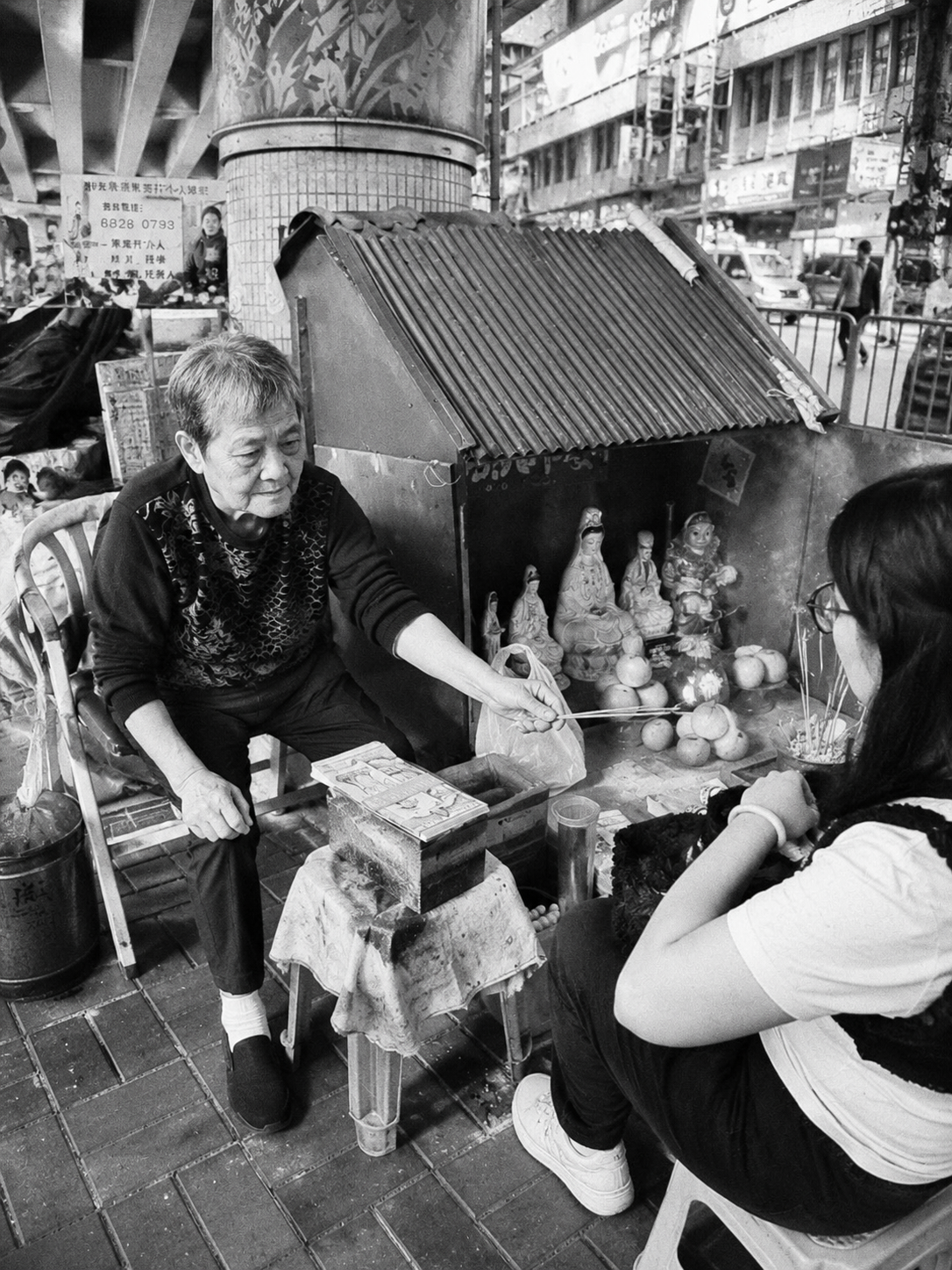
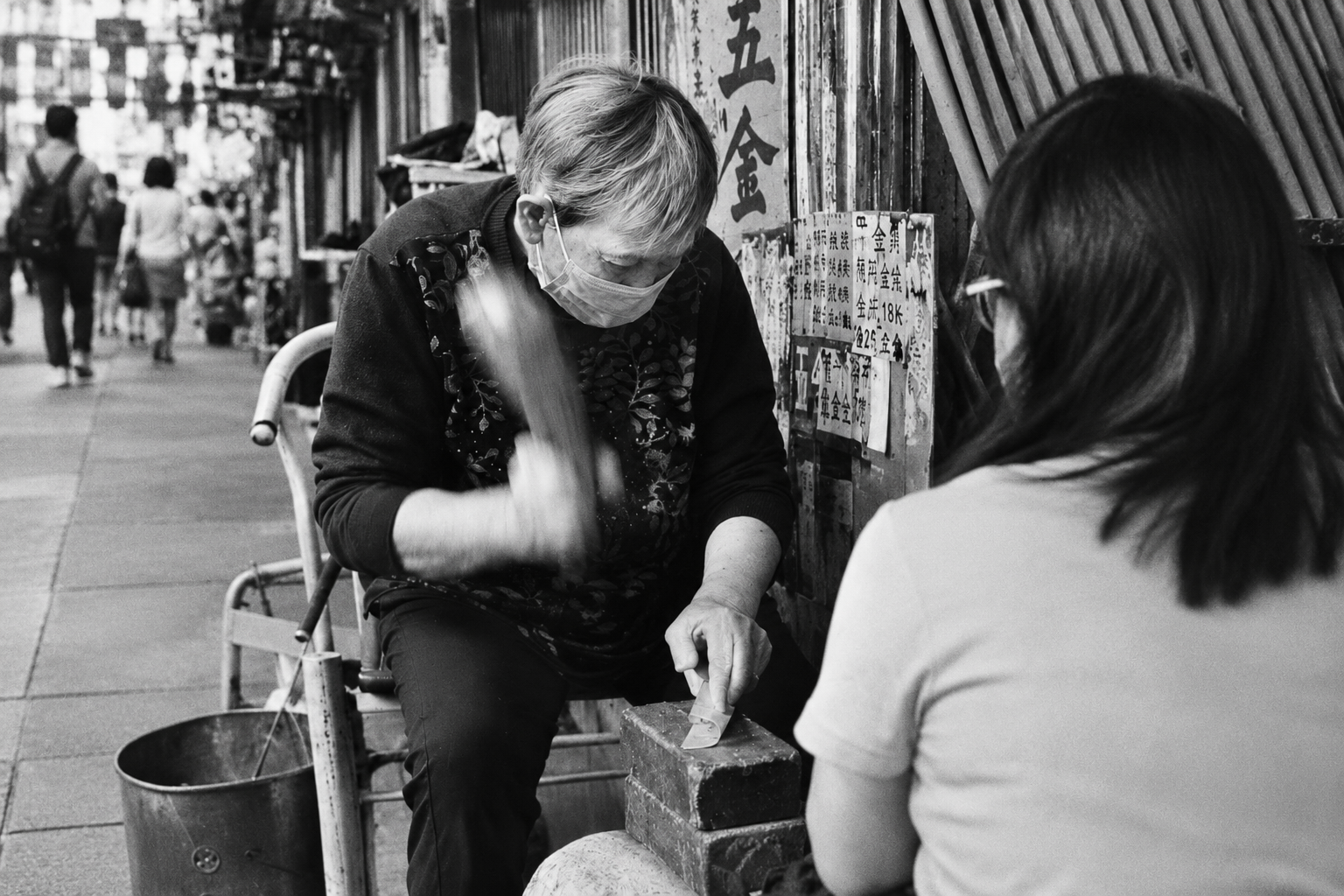
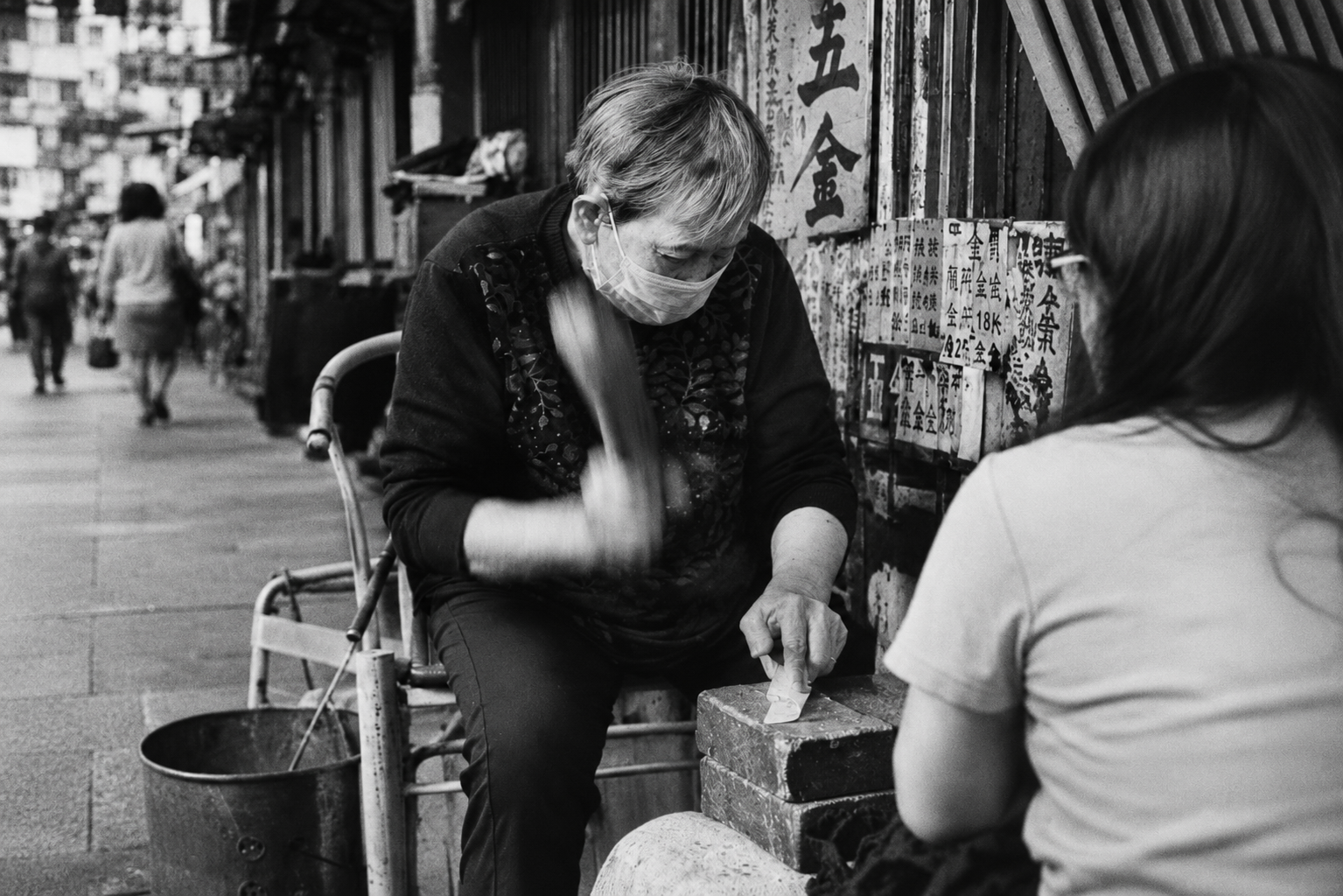
I watched as she prepared for another customer. A small paper figure was placed on the ground, surrounded by the familiar objects of the ceremony. There were prayers, deliberate gestures and the careful arrangement of offerings. Then came the shoe, an elderly specimen whose best days as footwear were clearly behind it but whose second career appeared to be flourishing.
The first blow landed with a sharp slap against the paper. Then another, followed by several more, delivered with the confidence of someone who had performed this particular duty thousands of times and had no reason to doubt its effectiveness.
I raised my camera.
There was something irresistibly theatrical about the scene. The principal performer was an old shoe, the supporting cast consisted largely of invisible enemies, and the audience hoped that the entire production would improve its personal circumstances. Yet nothing about the woman’s movements suggested comedy. She worked with concentration and precision, her hands following a rhythm established through years of repetition.
The paper shifted beneath each blow. Incense smoke drifted across the ground, catching occasional fragments of light from the street. Her fingers moved between the offerings, the paper figures and the objects arranged beside her. I watched the sequence through the viewfinder, waiting for those brief moments when gesture, expression and light came together.
As a photographer, I was fascinated. As a potential customer, I began to consider the possibilities.
There was the man who once parked across my driveway, the airline that misplaced my suitcase, and the person responsible for inventing automated telephone menus that insist your call is important while doing everything possible to prevent you from speaking to another human being. I could also think of whoever decided that a modern camera should require seventeen pages of menus merely to change a simple setting.
My list was growing alarmingly long. At fifty dollars per enemy, I wondered whether Auntie Yung offered a discount for bulk orders.
The ceremony, known in Cantonese as Da Siu Yan, or Villain Hitting, belongs to Hong Kong’s traditional folk culture. The paper figure represents a troublesome individual or an unwelcome influence, and the blows are intended to drive away misfortune, conflict and the difficulties that other people have brought into one’s life.
There is something rather appealing about the directness of the idea. Modern society offers expensive therapy, motivational seminars, mindfulness applications and an apparently endless supply of books explaining how to forgive people who have behaved like complete idiots. Here, the same emotional territory is approached with prayers, incense and a shoe.
The simplicity is refreshing.
Of course, the ritual is more than an exercise in symbolic aggression. Its traditions include blessings for protection, offerings intended to restore harmony and ceremonies associated with the spiritual forces believed to influence everyday life. The White Tiger receives its offerings, the Heavenly Dog is encouraged to depart, and various unfortunate influences are politely, or perhaps not so politely, informed that their presence is no longer required.
The symbolism is complex, and its roots reach much further into Hong Kong’s history than the concrete bridge above us. Yet its immediate appeal is easy to understand. People come carrying worries, frustrations and the uncomfortable feeling that circumstances have escaped their control. The ceremony gives those concerns a visible form and allows something to be done about them.
Whether the universe takes notice is another matter. The person paying fifty dollars may already feel that a small victory has been achieved.
I continued photographing, careful not to interrupt the proceedings. The most interesting moments were not always the blows themselves. Sometimes it was the pause before the shoe descended, the concentration in a pair of ageing hands, or the quiet rearrangement of a paper figure after the ritual had ended. In those intervals, the performance became something more intimate, revealing the ordinary work behind an extraordinary occupation.
Auntie Yung seemed entirely at ease with the world around her. The passing pedestrians, the traffic, the occasional curious visitor and the presence of cameras were simply part of her working day. What appeared unusual to me was, for her, an established routine.
I tried to imagine explaining the afternoon to someone back in Germany.
They would ask what I had photographed in Hong Kong, and I would explain that I had spent part of the day watching a woman beat someone with a shoe. Naturally, they would want to know whether there had been a fight. I would tell them that it was a religious folk ritual, that nobody had been injured and that the victim had been made of paper.
At this point, the conversation would probably become difficult.
If they asked whether the ritual had worked, I could only reply that this depended on whether the paper had enemies of its own.
I doubt the explanation would improve matters.
What interested me most was how naturally this small world existed within the enormous machinery of Hong Kong. Only a few metres away, people were checking their phones, buying coffee, discussing property prices and rushing towards meetings whose importance would probably be forgotten by the following week. Beneath the bridge, someone was negotiating with fate through incense, prayers and carefully administered blows from an old shoe.
One world placed its confidence in financial forecasts. The other relied on fortune-telling.
Having observed both, I am not entirely convinced that the financial forecasts deserve their reputation for superior accuracy.
Eventually, I lowered my camera and watched without the interruption of a viewfinder. Another customer arrived, another paper figure was prepared, and the familiar sequence began again. Above us, a bus struggled through the traffic, its engine contributing a steady mechanical accompaniment to the ceremony below.
I had come expecting to photograph an unusual local tradition. Instead, I found myself thinking about the peculiar ways human beings deal with frustration, uncertainty and the people who make life unnecessarily complicated.
We all have our methods. Some go running, others meditate, and many prefer to complain on social media, where they can be reasonably certain of finding several thousand strangers willing to make the situation worse. Some of us buy another camera lens that we absolutely do not need, convinced that the next piece of glass will somehow bring order to our creative lives.
And some visit Auntie Yung beneath Goose Neck Bridge.
As I walked away, I briefly considered returning to pay the fifty dollars myself. There were certainly enough candidates to justify the expense, although I would have needed a rather complicated system for deciding who deserved priority.
Then I remembered that I was carrying a vintage camera, several rolls of film and an assortment of photographic equipment whose combined value would have made a respectable offering to almost any deity.
Perhaps I had already demonstrated sufficient faith.
Besides, if the gods genuinely wished to improve my fortune, they could begin with something modest and entirely practical: ensuring that my next roll of film came back from the laboratory properly developed, without scratches, fingerprints or mysterious marks that nobody could explain.
I would consider that a miracle worth paying for.
Some people believe in karma. Others prefer to give it a little encouragement with an old shoe.